Introduction
Digital fabrication is a design and manufacturing workflow where digital data directly controls a device like a 3D printer, a laser cutter or a CNC (computer numerical control) milling machine, to form various part geometries.
History
The first machine that had the ability to be programmed and was used to manufacture a product was the Jacquard loom. It was invented in 1806 by Joseph Marie Jacquard, a French weaver and merchant. Possibly inspired by player pianos, instructions for textile patterns were coded in a sequence of punched cards.
In a similar manner, perforated paper rolls were used to control an automatic lathe developed in 1948 by Frederick Cunningham at the Arma corporation.
Adrian Holmberg & Goss-Dexter
Driven by the demand of the evolving aircraft industry for high precision parts with complex outlines like airfoil profiles, the It’s history reaches back (at least) as far as 1959, when an ashtray was milled as part of the APT (Automatically Programmed Tool) project, developed by the Computer Applications Group within the Servomechanisms Laboratory at MIT.
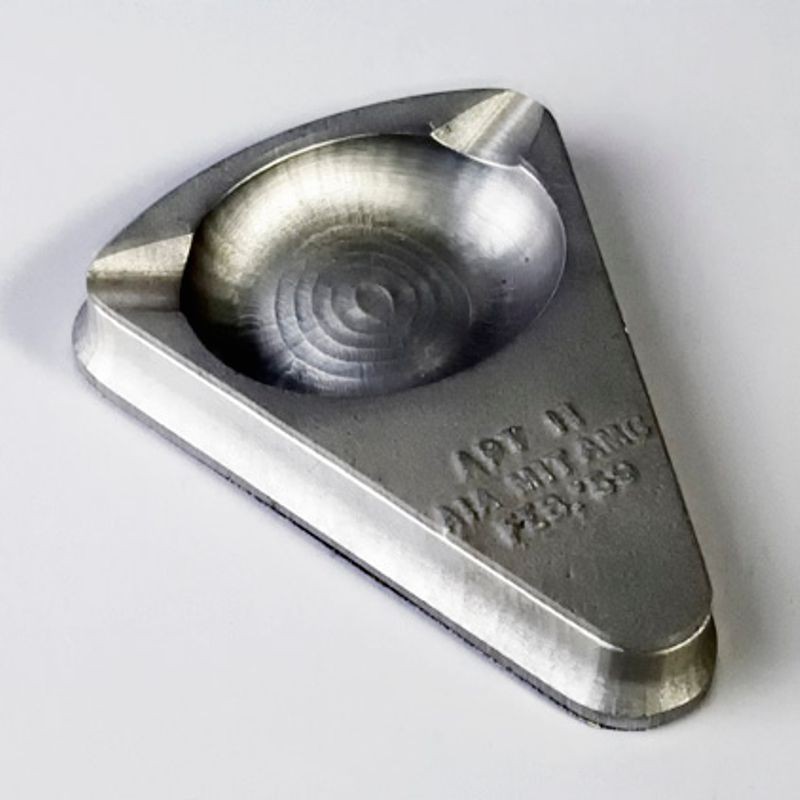
APT II Ashtray (Source: Computer History Museum)