Climate Change
Rising temperatures
Over the last 40 years an increase in the global average temperature across land and ocean surface areas can be wittnessed:
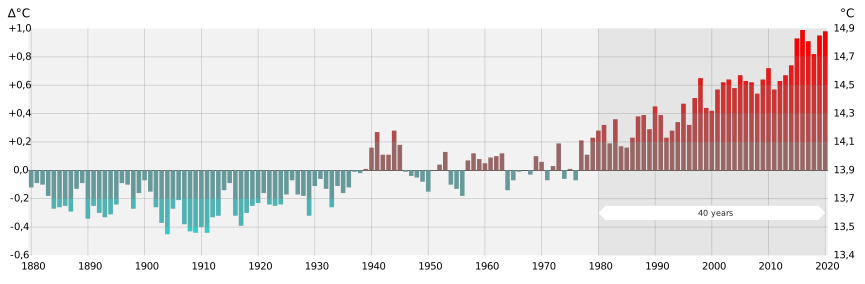
Global anuual average surface temperature records since 1880 (Source: NOAA)
2016 was the warmest year in the 141-year series of records (1980-2020) with an annual average of +0.99 °C anomaly relative to the 20th century (1901-2000) average of 13.9 °C.
2016 was also the third consecutive year to set a new temperature record.
The 5 warmest years have all occurred within the last 6 years.
All 20 years of the 21st century rank among the 19 warmest on record (with 1998, the year with an especially intense El Niño phenomenon, currently at the 11th rank).
All 44 years since 1977 have been above the 20th century average.
Overall, the global annual temperature has increased at an average rate of 0.08 °C per decade since 1880 and at an average rate of 0.18 °C per decade since 1970.
A +0.99 °C increase is significant because it takes a vast amount of heat to warm all the oceans, land and atmosphere. To put this number in perspective: about 21,000 years ago, at the Last Glacial Maximum, the climate was 4–7 °C cooler, resulting in up to 3 km thick ice sheets in the Northern Hemisphere and global mean sea levels 120 m below present day values.
Earth’s climate system
The Earth’s climate system is powered by solar radiation. It evolves in time under the influence of its own internal dynamics and because of substances and processes that alter the balance of incoming and outgoing energy. Radiative forcing is a measure that quantifies those changes in energy flux relative to the pre-industrial conditions in 1750. Radiative forcings can be natural, e.g.
volcanic eruptions,
solar and orbital variations,
or anthropogenic (= human caused), e.g.
changing the composition of the atmosphere and
land-use change.
In relation to 1750 they can be either negative or positive.
Negative radiative forcings contribute to a cooler climate, e.g. fresh snow reflects most of its incoming solar radiation back to space. Positive radiative forcings contribute to a warmer climate, e.g. the greenhouse effect, where solar shortwave radiation (= visible light) passes the atmosphere and is absorbed by the Earth’s surface and, according to Wien’s displacement law since the Earth’s surface temperature (ca. 290 K) is lower than the sun’s (ca. 5,800 K), emitted back as longwave radiation (= infrared light), but largely absorbed by certain atmospheric constituents like water vapour, carbon dioxide (CO2), methane (CH4), nitrous oxide (N2O) and other greenhouse gases (GHGs).
If the incoming solar radiation is equal to the outgoing radiation of the Earth, its energy budget is balanced and its global average temperature will stay at a certain level. If the global average radiative forcing is positive and thus more solar radiation gets absorbed then radiated back, the Earth’s temperature and radiation increases to the level where the energy budget is in balance again.
Human influence
Taking natural forcings and the natural internal climate variability into account, human influence has been the dominant cause of the observed warming since the mid-20th century.
The largest contribution to total radiative forcing is caused by the increase in the atmospheric concentration of CO2 since 1750. Since then concentrations have risen from 280 ppm (parts per million, 280 ppm = 0.028%) to just over 400 ppm as of today. More than three quarters of the added anthropogenic CO2 come from fossil fuel combustion and industrial processes.
Carbon cycle
Carbon is the 4th most abundant element in the Universe and essential to life as we know it. Regarding matter, planet Earth is an isolated system (virtually nothing is added or removed) with almost 99.9% of Earth’s carbon stored in rocks (= lithosphere). The other 0.01% are stored in the oceans (= hydrosphere), fossil fuels, biomass (= biosphere) and the atmosphere. The carbon cycle describes the exchange of carbon between each of those reservoirs, which has fast and slow pathways.
A fast pathways is photosynthesis, where energy in the form of light is converted into chemical energy and stored in carbohydrate molecules such as sugars. This process removes CO2 from the atmosphere, stores the carbon (C) in biomass and leaves the oxygen (O2) in the atmosphere. In other words photosynthesis stores energy and moves carbon from the atmosphere to the biosphere. Any process that decomposes or burns biomass, releases the energy and moves the carbon back to the atmosphere.
A slow pathway is the process that formed fossil fuels. They are also biomass and contain high percentages of carbon but store the energy from ancient sunlight millions of years ago buried deep in the ground. The burning of fossil fuels is an additional, anthropogenic source of carbon, that increases the amount of CO2 in the atmosphere.
Another source of anthopogenic CO2 is land-use change, e.g. by converting a forest into agricultural land biomass is removed and its carbon content released to the atmosphere.
Carbon budget
The Paris Agreement proposed to keep the increase in global average temperature to well below 2 °C above pre-industrial levels and to pursue efforts for an even lower 1.5 °C goal. To be able to achieve the 2 °C goal the total amount of accumulated anthropogenic CO2 has to be limited to 2,900 GtCO2 (giga-tonnes carbon dioxide). As to date 65% of this carbon budget have already been spent, leaving a remaining amount of 1,000 GtCO2.
Distributing the budget of 1,000 GtCO2 evenly among the current world population of 7.5 billion over the next 50 years results in a CO2 budget of 2.7 tonnes of CO2 per capita per year. While the global average currently is around 4.8 the developed countries have a significant higher average: Quatar 40; Australia: 18; U.S.A. 16. Russia: 12; China: 8; European Union: 7. When the budget is spent, no more CO2 must be added to the atmosphere to stay within the 2 °C limit.
Fundamental physical limits
Fossil fuels are a composite of hydrocarbons = molecules consisting entirely of hydrogen (H) and carbon (C). The amount of CO2 that will be released during combustion is determined by its carbon content only, the amount of energy is determined by the amount of carbon and hydrogen.
Combusting one liter of gasoline releases 2.3 kg of CO2. Diesel has a higher carbon and energy content releases 2.7 kg CO2 per liter.
The targeted yearly budget per capita of 2.7 tonnes CO2 is spent after driving 20,000 km with any car that consumes 6 l gasoline (or 5 l diesel) per 100 km. Or with a single one-way scheduled economy-class flight from Vienna to Los Angeles.
The achievable efficiency of any heat engine is limited by the maximum specified by Carnot’s theorem, which is a result of the second law of thermodynamics. Thus the only feasible solutions to lower the emissions for transportation are e.g. lighter vehicles or shorter distances.
Further reading
Rockström et al. (2009) – A safe operating space for humanity
2 1/2 months ahead of the 2009 United Nations Climate Change Conference in Copenhagen, Johan Rockström and Will Steffen in collaboration with 26 leading academics proposed a framework based on 9 ‘planetary boundaries’. Each crossing could result in irreversible and, in some cases, abrupt environmental change, leading to a state less conducive to human development. Climate change is one of the three boundaries that have been considered as already crossed at the time of the report.
_
Intergovernmental Panel on Climate Change Assessment Reports
The IPCC was set up under the auspices of the United Nations in 1988 at the request of member governments and is dedicated to the task of providing the world with an objective, scientific view of climate change and its political and economic impacts. The reports and their conclusions are built on many thousands peer reviewed sources.
To date the IPCC has published five comprehensive assessment reports reviewing the latest climate science:
1990: First Assessment Report (FAR)
1995: Second Assessment Report (SAR)
2001: Third Assessment Report (TAR)
2007: Fourth Assessment Report (AR4)
Landing Page2014: Fifth Assessment Report (AR5)
Landing Page
Each assessment report is split over three volumes, corresponding to the three Working Groups
Working Group I (WG1): The Physical Science Basis
Working Group II (WG2): Impacts, Adaptation, and Vulnerability
Working Group III (WG3): Mitigation of Climate Change
with an additional
Synthesis Report (SYR)
since SAR as a fourth volume. Each volume has a condensed Summary for Policymakers (SPM).
IPCC AR4 (2007)
Working Group I (2007): Climate Change 2007: The Physical Science Basis
Landing Page | Full Report | Summary for PolicymakersWorking Group II (2007): Climate Change 2007: Impacts, Adaptation, and Vulnerability
Landing Page | Full Report | Summary for PolicymakersWorking Group III (2007): Climate Change 2007: Mitigation of Climate Change
Landing Page | Full Report | Summary for PolicymakersClimate Change 2007: Synthesis Report
Landing Page | Full Report | Summary for Policymakers
IPCC AR5 (2014)
Working Group I (2013): Climate Change 2013: The Physical Science Basis
Landing page | Full Report | Summary for PolicymakersWorking Group II (2014): Climate Change 2014: Impacts, Adaptation, and Vulnerability
Landing Page] | Full Report, Part A | Full Report, Part B | Summary for PolicymakersWorking Group III (2014): Climate Change 2014: Mitigation of Climate Change
Landing page | Full Report | Summary for PolicymakersClimate Change 2014: Synthesis Report
Landing page | Full Report | Summary for Policymakers
The Sixth Assessment Report (AR6) is scheduled to be completed in the first half of 2022.
IPCC AR6 (2021)
Working Group I (2021): Climate Change 2021: The Physical Science Basis
Landing page | Full Report | Summary for Policymakers
National Oceanic and Atmospheric Administration (NOAA)
The NOAA releases a collection of monthly summaries recapping climate-related occurrences on both a global and national scale:
Climate Monitoring → State of the Climate → Global Climate Report
It also publishes the time series of global temperature anomalies since 1880 in respect to the 20th century average:
Climate Monitoring → Climate at a Glance → Global Time Series
National Air and Space Administration’s Goddard Institute for Space Studies (NASA/GISS)
The NASA/GISS global surface temperature records are also available to the public. The anomalies since 1880 are in respect to the 1951 – 1980 average.
Global Climate Change → Facts /Vital Signs → Global Temperature